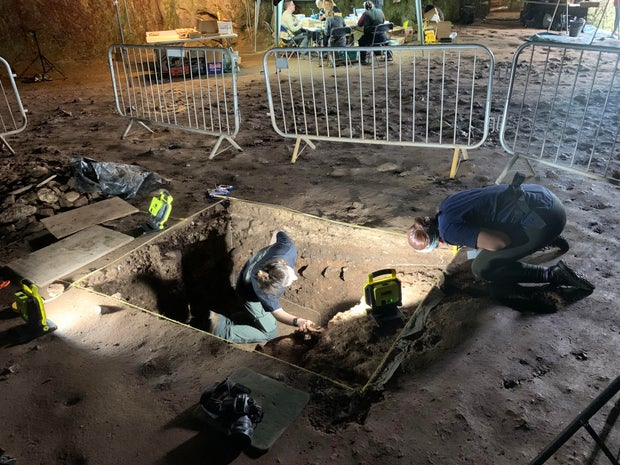
**Excerpt:** A hidden cave beneath Pembroke Castle in Wales has yielded prehistoric hippo bones, prompting excitement among researchers who call it a “once-in-a-lifetime discovery.”
Key Points
– A prehistoric cave and hippo bones were discovered beneath Pembroke Castle in Wales.
– The site is believed to have housed early humans and extinct species over 120,000 years ago.
– The excavation is part of a five-year project led by the University of Aberdeen.
– Findings include evidence of Neanderthals and early Homo sapiens, as well as bones from mammoths and woolly rhinoceroses.
– The research aims to provide insights into past climate change and human activity over millennia.
Discovery Details
Researchers announced the discovery of a hidden prehistoric cave and hippo bones located beneath Pembroke Castle, a historic site in Wales. They describe the find as a “once-in-a-lifetime discovery” that could greatly enhance understanding of ancient life in Britain.
Excavation Overview
Previous excavations at Pembroke Castle, known as the birthplace of Henry Tudor, uncovered evidence of early human and animal life, including the now-extinct hippopotamus that lived in Wales approximately 120,000 years ago. The current excavation is part of a significant five-year archaeological project spearheaded by the University of Aberdeen.
Rob Dinnis, the project leader, emphasized the uniqueness of the site, stating, “There is no other site like it in Britain.” The cave, initially believed to have been emptied during the Victorian era, has now been identified as a key prehistoric archive.
Findings and Significance
So far, the excavations have revealed rare evidence related to early Homo sapiens, along with indications of even earlier Neanderthal habitation. Notably, the researchers discovered hippo bones dating back to the last interglacial period. Other significant findings include bones from mammoths, woolly rhinoceroses, and reindeer, alongside stone tools indicative of human occupation across various periods.
Dinnis noted that the site might reveal a long sequence of human activity, from hunter-gatherers emerging after the last Ice Age to some of Britain’s earliest Homo sapiens. The research aims to offer insights into past climates, extinct species, and the timeline of human habitation.
Future Excavations
Larger-scale excavations are set to resume in May, with researchers optimistic about uncovering more artifacts and data. Professor Kate Britton from the University of Aberdeen highlighted the potential for the project, stating, “Because the bones are well preserved, we can learn a lot about past environments and ecosystems.”
The discovery of the cave and its contents adds a new layer to the historical significance of Pembroke Castle, which has long been recognized as a medieval fortress and the birthplace of Henry VII. Castle manager Jon Williams expressed excitement about the ongoing work, calling it “incredibly exciting news” for the site.
Leave a Reply