**Excerpt:** A geomagnetic storm watch has been issued after a significant solar flare occurred over the weekend, potentially affecting technology and visibility of the Northern Lights.
Key Points:
– A powerful X1.9 solar flare erupted on November 30, impacting radio communications.
– A coronal mass ejection (CME) accompanied the flare, which may lead to geomagnetic storms.
– The NOAA has issued a geomagnetic storm watch for December 4, with possible effects beginning December 3.
– Visibility of the Northern Lights may be possible in northern U.S. states.
– Scientists anticipate increased solar activity due to a newly emerging sunspot.
Solar Flare Details
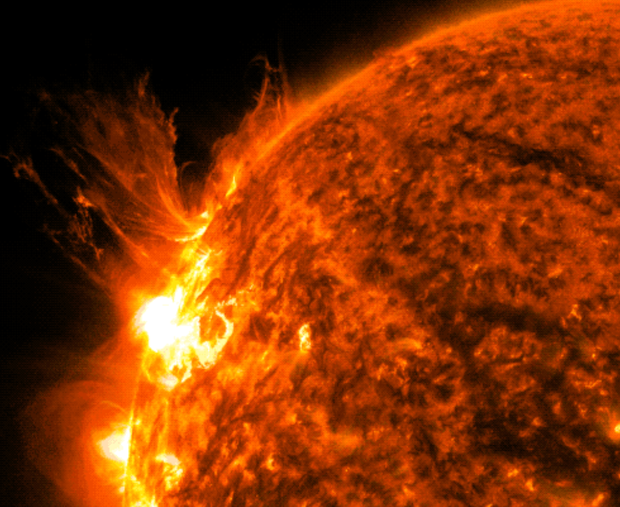
On November 30, at 9:49 p.m. EST, a significant solar flare classified as X1.9 erupted from the sun, as reported by NASA’s Solar Dynamics Observatory. This type of flare represents one of the most intense classifications, and it emerged from a newly formed sunspot region.
Impact on Communications
The solar flare briefly disrupted radio communications in Australia and parts of Southeast Asia on December 2. Accompanying the flare was a coronal mass ejection (CME), where solar material and magnetic fields are expelled from the sun. While flares and CMEs are related, they are distinct phenomena. Both can affect radio communications, power grids, and navigation signals, and pose risks to spacecraft and astronauts.
Geomagnetic Storm Watch
The National Oceanic and Atmospheric Administration (NOAA) has issued a geomagnetic storm watch for December 4. Although the CME is not expected to directly reach Earth, NOAA predicts it could have minor effects on technological infrastructure. The forecast remains somewhat unpredictable, with the possibility of the storm arriving as early as December 3.
Northern Lights Visibility
As a result of the solar activity, there may be opportunities to observe the Northern Lights across northern and upper states, including areas between New York and Idaho. However, a powerful winter storm may hinder visibility.
Future Solar Activity
NOAA scientists expect heightened space weather activity from December 1 to December 5 due to the rotation of the sunspot region AR4299, which is the source of the recent solar flare and CME.
Leave a Reply