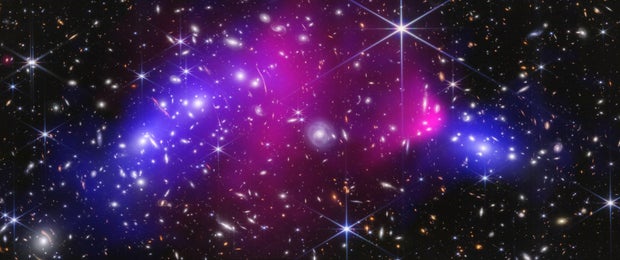
**Excerpt:** A new map of distant galaxies created by the James Webb Space Telescope sheds light on dark matter, a crucial but elusive component of the universe.
Key Points
– A new high-resolution map shows nearly 800,000 galaxies and their dark matter connections.
– Dark matter constitutes over 25% of the universe, while ordinary matter makes up only 5%.
– The map, published in Nature Astronomy, has twice the resolution of previous Hubble images.
– Scientists can study the distribution of dark matter over 10 billion years.
– Understanding dark matter is key to unraveling the universe’s formation.
Introduction
A recent high-resolution map of distant galaxies offers new insights into dark matter, an invisible substance that plays a critical role in the structure of the universe. This groundbreaking work utilizes data from NASA’s James Webb Space Telescope (JWST) and aims to enhance our understanding of this mysterious component.
Dark Matter: The Invisible Force
Ordinary matter, which includes stars, planets, and living beings, accounts for just 5% of the universe. In contrast, dark matter makes up over 25%, with dark energy comprising the rest. Although dark matter cannot be observed directly because it neither absorbs nor emits light, scientists can infer its presence by examining its gravitational effects on visible matter, such as the bending of light from distant galaxies.
The New Map
The latest map, released in the journal *Nature Astronomy*, is the most detailed to date, featuring nearly 800,000 galaxies, some identified for the first time. This map boasts double the resolution of earlier images captured by the Hubble Space Telescope and covers an extensive area of the sky, representing galaxies from the past 10 billion years.
Diana Scognamiglio, a study author at NASA’s Jet Propulsion Laboratory, remarked, “Now, we can see everything more clearly.” The new data includes information on galaxy clusters and the strands of dark matter connecting them, which serve as the framework for the universe.
Implications of the Findings
Astrophysicist Richard Massey, a coauthor of the study, explained that wherever large clusters of galaxies exist, there is also a significant concentration of dark matter. The study’s findings will help scientists understand how dark matter has clumped over billions of years, contributing to the overall structure of the universe.
Astrophysicist Rutuparna Das from the Harvard-Smithsonian Center for Astrophysics emphasized the importance of understanding dark matter as part of humanity’s quest to comprehend our origins and the universe itself.
Conclusion
This map not only enhances our understanding of dark matter but also contributes to the ongoing exploration of the universe’s formation. As researchers continue to study this data, we can expect further revelations about the cosmos and the fundamental forces that shape it.
Leave a Reply