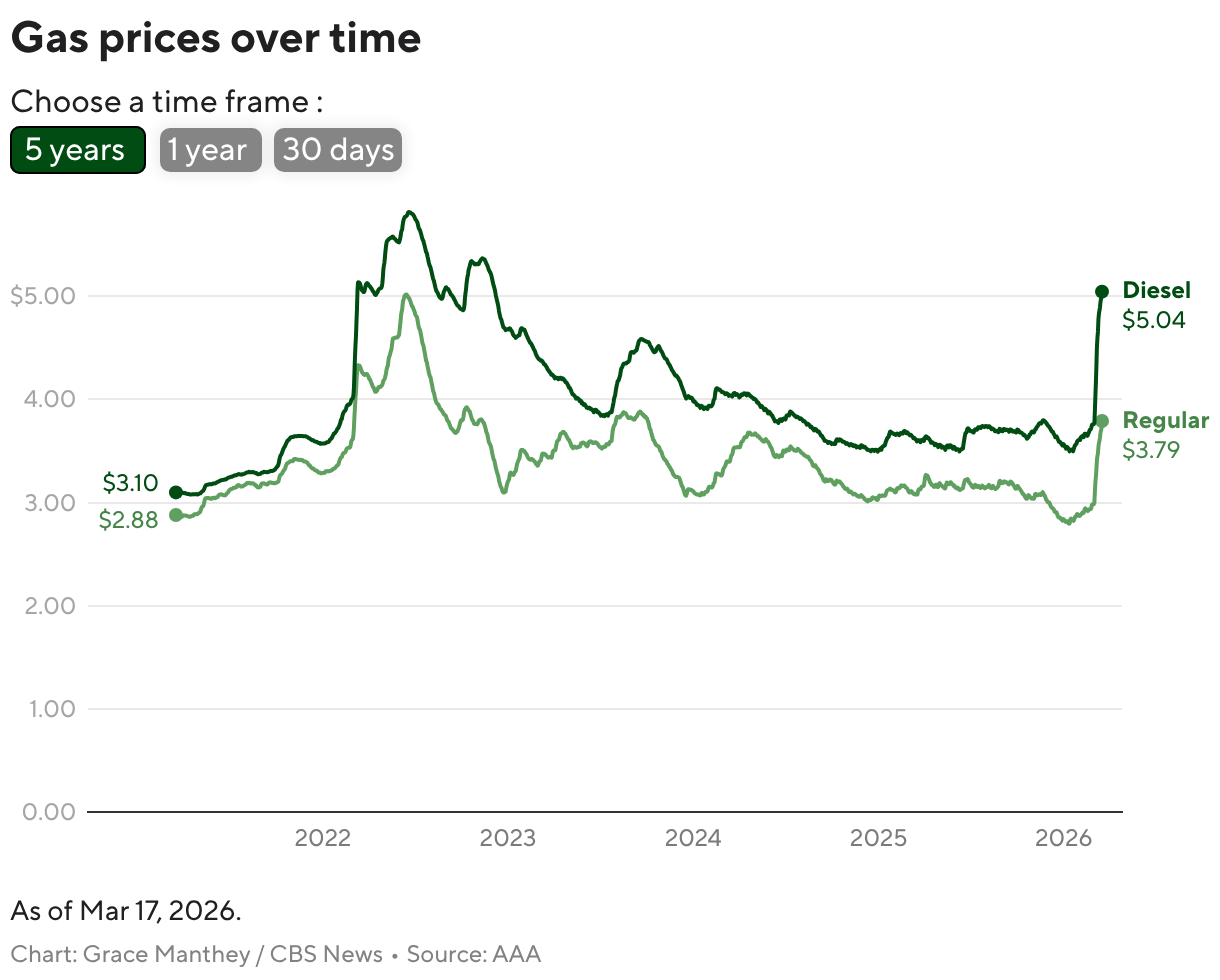
**Excerpt:** Gas prices in the U.S. have surged significantly due to the ongoing Iran war, raising questions about the impact of global oil markets on domestic prices.
Key Points:
– U.S. gas prices have increased from $2.92 to $3.79 per gallon in just one month.
– Despite being the world’s top oil producer, the U.S. exports much of its crude oil.
– Global oil prices drive domestic fuel costs, independent of U.S. production levels.
– U.S. refineries are primarily designed for heavy crude oil, complicating adjustments for lighter crude.
– Rising oil prices are also increasing airline ticket prices, with domestic fares up by as much as 124%.
Overview of Rising Gas Prices
Motorists across the United States are experiencing a sharp increase in fuel prices, primarily attributed to the ongoing conflict related to Iran. Despite the U.S. being the world’s largest oil producer, the average gas price has risen significantly, reaching $3.79 per gallon from $2.92 in just a month as reported by AAA.
The U.S. Oil Production Context
As of 2023, the U.S. produces approximately 13 million barrels of crude oil daily, significantly more than Russia and Saudi Arabia, which each produce around 10 million barrels. However, much of this production is exported. The U.S. exports about 11 million barrels daily while also importing around 8 million barrels, making it the largest consumer of oil globally.
Market Dynamics
The global oil market largely sets fuel prices. Bernard Yaros, an economist at Oxford Economics, explains that the source of oil used in U.S. gas tanks is irrelevant; what matters is the global pricing structure. The complexity of the oil market means that even as a net exporter, the U.S. remains vulnerable to international oil price fluctuations.
Refinery Limitations
Most U.S. oil production consists of light crude, which is in high demand internationally. However, U.S. refineries are predominantly configured for heavy crude oil, making it challenging to adapt quickly to process lighter varieties. Former U.S. Secretary of Energy Ernest Moniz highlights that the specific characteristics of oil from various regions lead to inefficiencies in the refining process.
Impact on Consumers
The interlinked nature of oil prices means that increases not only affect consumer gasoline prices but also extend to other sectors, such as air travel. Recent analysis indicates an increase in domestic airfares, with prices rising between 15% and 124% for flights booked later in March.
Moniz reinforces that an increase in oil prices affects the entire economy, leading to higher costs across multiple sectors despite the U.S.’s status as a net oil exporter.
Leave a Reply