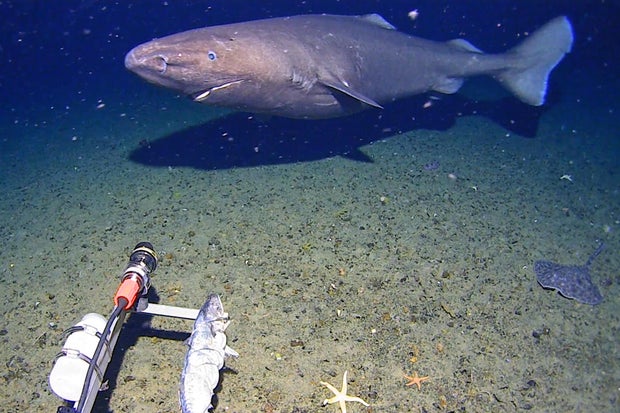
*Researchers capture footage of a sleeper shark in Antarctica, a sight previously thought impossible.*
Key Points
– A sleeper shark was recorded in Antarctic waters, contrary to previous beliefs.
– The shark was filmed at a depth of 1,608 feet with a temperature of 34.29°F.
– Researchers had not documented any sharks in the Antarctic Ocean until this sighting.
– The presence of sharks in these waters may relate to climate change.
– Limited research cameras in the area mean more surprises could be uncovered.
Full Article
Shark Sighting in Antarctica
In a surprising discovery, researchers captured video footage of a sleeper shark in the frigid waters of Antarctica, a region where experts previously believed sharks did not exist. The footage, recorded in January 2025, shows a substantial sleeper shark estimated to be between 10 and 13 feet long.
Research Background
Alan Jamieson, a researcher at the University of Western Australia and director of the Minderoo-UWA Deep-Sea Research Centre, noted that the camera was positioned near the South Shetland Islands, deep into the Antarctic Ocean, which is defined as being below the 60-degree south latitude line.
“This is significant because we went down there not expecting to see sharks,” Jamieson stated. “It’s not even a little one either. It’s a hunk of a shark.”
The shark was filmed at a depth of 1,608 feet, where the water temperature was a near-freezing 34.29°F. The footage also captured a skate, a relative of sharks, resting on the seabed, which scientists already knew inhabited these waters.
Implications of the Discovery
Jamieson, who could not find any prior records of sharks in the Antarctic Ocean, emphasized the rarity of the sighting. Peter Kyne, a conservation biologist from Charles Darwin University, corroborated that a shark had never been documented this far south before.
Experts suggest that climate change and warming ocean temperatures might be encouraging sharks to venture into colder waters. However, data on range changes in the region remains limited due to its remoteness.
Future Research Opportunities
Jamieson indicated that the sleeper shark population in the Antarctic Ocean is likely sparse and difficult to detect. The shark was maintaining a depth of approximately 1,640 feet, which is believed to be the warmest layer in a stratified water column that extends down to around 3,280 feet.
He noted, “There are few research cameras positioned at that specific depth in Antarctic waters, and those that are can only operate during the Southern Hemisphere summer months.” This means that for about 75% of the year, there is little to no observation of these depths, allowing for the possibility of further unexpected discoveries in the future.
Leave a Reply