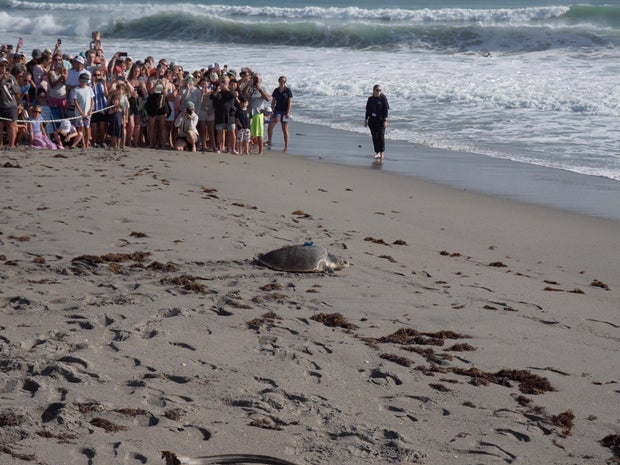
**Excerpt:** A Kemp’s ridley sea turtle, Amelie, has been released into the Atlantic Ocean after rehabilitation and is now being monitored using satellite tracking technology.
Key Points
– Amelie, a Kemp’s ridley sea turtle, lost her right forelimb to a predator and was rehabilitated at the Loggerhead Marinelife Center in Florida.
– The turtle was released back into the wild with a satellite tracking device attached to her shell.
– Amelie is the fourth amputee sea turtle being tracked, contributing to research on their survival and behaviors.
– The study aims to understand their dive patterns and migration after rehabilitation.
– Satellite data shows Amelie’s location and activities in the wild, providing valuable insights for conservation.
The Rehabilitation Journey of Amelie
In Juno Beach, Florida, veterinary staff at the Loggerhead Marinelife Center are utilizing satellite tracking technology to monitor rehabilitated sea turtles, particularly those with amputations. Amelie, a Kemp’s ridley sea turtle who lost her right forelimb to a predator, was released into the Atlantic Ocean on March 25, 2026.
Release into the Wild
After a seven-week rehabilitation period, Amelie was deemed healthy enough to return to the sea. She underwent surgery to treat her injury and received care for pneumonia during her stay at the center. The release event drew attention as onlookers cheered while Amelie paused briefly on the beach before entering the ocean.
Significance of Tracking Amelie
Amelie is the fourth sea turtle with an amputation being tracked by the Loggerhead Marinelife Center. The tracking initiative, in collaboration with the Smithsonian Conservation Biology Institute, seeks to gather data on how well these turtles adapt and survive in the wild after losing a limb. The center’s research director, Sarah Hirsch, noted that the satellite tags help track the turtles’ dive behaviors and migration patterns.
Insights from Satellite Tracking
The satellite tracking devices feature a saltwater switch that activates when the turtle surfaces to breathe, sending location data to satellites. This information is made available online after a 24-hour delay. Amelie’s tracking will provide researchers with important insights into the behavior and survival of amputee sea turtles in their natural habitat.
Conclusion
As sea turtle populations face threats from human activities and environmental changes, understanding the recovery and survival of rehabilitated turtles like Amelie is crucial. The Loggerhead Marinelife Center’s efforts highlight the importance of conservation and the innovative use of technology in wildlife monitoring.
Leave a Reply