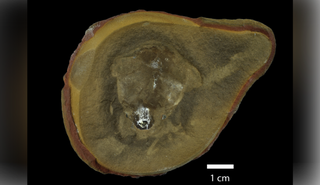
**Excerpt:** A prehistoric fossil once believed to be the oldest octopus has been identified as a relative of a nautilus, shifting our understanding of cephalopod evolution.
Key Points:
– The fossil Pohlsepia mazonensis, previously classified as an octopus, is now identified as a nautilus relative.
– The discovery was made by researchers from the University of Reading using advanced imaging techniques.
– The fossil was found in Illinois, dating back to a time before dinosaurs roamed the Earth.
– This revelation contradicts earlier beliefs about the timeline of octopus evolution.
– Guinness World Records will no longer list this fossil as the oldest known octopus.
Fossil Misclassification Revealed
A significant discovery has emerged in the field of paleontology, overturning previous assumptions about a prehistoric fossil. The fossil, known as Pohlsepia mazonensis, was long thought to be the oldest known octopus but has now been reclassified as a relative of the nautilus. This finding was led by Thomas Clements, a zoology professor at the University of Reading.
Research Findings
Clements explained that the fossil, initially identified in 2000, was subject to debate due to its ambiguous appearance. “It kind of just looks like a white mush,” he remarked. However, its resemblance to deep-water octopuses led scientists to assign it to that category.
The fossil, found in the Mazon Creek area of Illinois, is approximately 300 million years old, predating the dinosaurs. The previous classification suggested that octopuses emerged much earlier than believed, creating a gap in the evolutionary timeline. The next oldest known octopus fossil is around 90 million years old.
Advanced Imaging Techniques
To resolve the classification issue, Clements and his team utilized synchrotron imaging, which employs high-energy electrons to produce intense light beams. This technology allowed them to examine the fossil’s internal structure, revealing a radula—a ribbon of teeth typical of mollusks. Notably, the number of teeth found exceeded that of octopuses, confirming that the specimen could not be one.
Implications of the Discovery
The new findings are significant for both scientific understanding and public records. Following the publication of this research in the journal *Proceedings of the Royal Society B*, Guinness World Records announced that it would no longer list Pohlsepia mazonensis as the oldest known octopus. Adam Millward, Managing Editor at Guinness, acknowledged the importance of this discovery.
Conclusion
Clements emphasized that this discovery highlights the value of revisiting historical scientific findings with modern techniques. The Field Museum in Chicago, which houses the fossil, is now recognized as holding the oldest soft tissue nautilus in the world. This reclassification not only clarifies the evolutionary narrative of cephalopods but also underlines the continuous evolution of scientific understanding.
Leave a Reply